

Deodorant stains on clothes: what causes them and how to get them out
Why deodorant leaves white, greasy or yellow marks on clothes, what laundry guides say to wash each one with, and why some yellow stains won't come out.
Quick answer
White deodorant marks are powder and usually wash out. Greasy marks come from the oils in a balm or stick and need liquid detergent rubbed in before the wash. Yellow, stiff patches on white shirts are linked to the aluminium salts in antiperspirants, and they may never fully come out. Keep a marked shirt out of the dryer until the mark has gone.
Types of deodorant marks
Most marks fall into one of these. We put this table together from two university laundry guides, an antiperspirant patent and Tide's stain guide (sources are linked in the sections below).
| What you see | What it usually is | What the guides say to try |
|---|---|---|
| White streaks, mostly on dark tops | Powder from the deodorant sitting on the fabric | Brush off what you can, then rub in liquid detergent and wash |
| A darker, damp-looking patch | Oil or butter from the deodorant | Rub in heavy-duty liquid detergent and wash in the hottest water the label allows |
| Yellow, stiff patch on white or light fabric | Antiperspirant aluminium salts combined with sweat and skin oil | Liquid detergent and a warm wash, though it may not come out |
| Colour faded or changed on a coloured top | Some antiperspirant salts are acidic and can change some dyes | A few drops of ammonia on a new mark, or white vinegar on an old one |
| Yellowing when you don't use an antiperspirant | Sweat | Liquid detergent, or a 20 to 30 minute soak in warm water with an enzyme product, then wash |
Why do antiperspirants leave yellow stains?
Yellow marks are linked to aluminium salts, the ingredient in an antiperspirant that cuts sweat, combined with sweat and the oil on your skin.
A Colgate-Palmolive patent on the problem says aluminium alone doesn't cause the yellowing. It helps bind skin oil and other soil to the fabric, and that oil then oxidises and turns yellow. The patent also says it shows most on white T-shirts and other light clothes (Colgate-Palmolive patent WO2011050044A1).
A 2017 textile study found that when aluminium chloride antiperspirants meet sweat and skin oil they form a gel that barely dissolves in water. On a shirt, that gel leaves yellowish stains that are very hard to shift in a normal machine wash (IOP Conference Series, 2017).
Susan Taylor from Iowa State University was asked about yellow T-shirts on The Naked Scientists. The shirts she described belonged to someone who put on a lot of deodorant, and she suggested using less and letting it dry a little before getting dressed (The Naked Scientists).
Do natural deodorants stain clothes?
They can, but the marks are different. Our balms don't contain the aluminium salts behind the yellow build-up above.
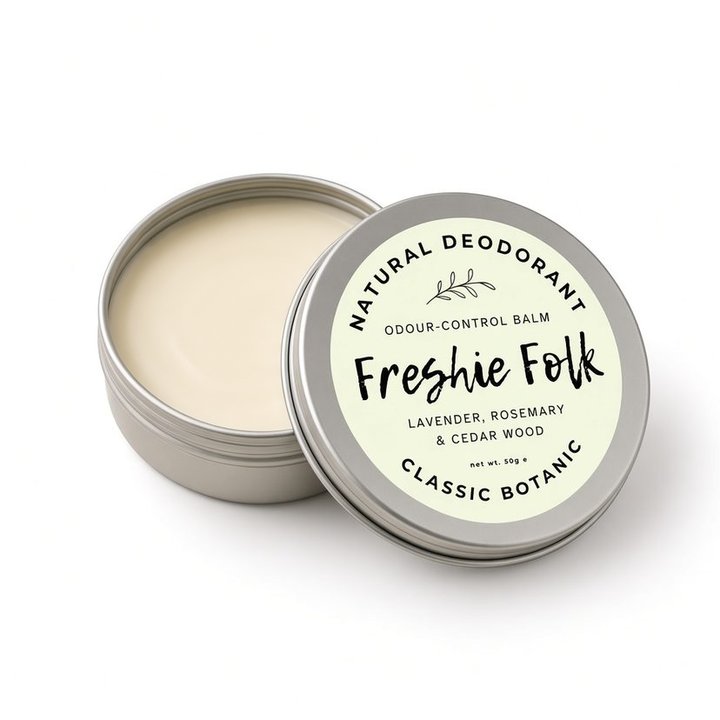
What a balm does have is white powders and oils. Ours has arrowroot, kaolin clay and sodium bicarbonate, which can leave a light white mark on a dark top. It also has shea butter, coconut oil, sunflower oil and beeswax, which can leave a greasy patch if a lot ends up on the fabric. If a balm is marking your shirts, you're most likely using more than you need. There's more on the white powder in our bicarb vs magnesium deodorant article.
Sweat can still mark clothes by itself. Texas A&M's laundry guide treats perspiration as a separate stain from deodorant, with its own steps.
How do you get deodorant stains out?
Treat the mark early with liquid detergent, then check it before anything goes in the dryer.
Texas A&M AgriLife Extension says to apply liquid detergent to a deodorant stain and wash in warm water with the usual amount of detergent (Texas A&M AgriLife Extension, Removing Stains from Washable Fabrics). For a greasy mark it gives the oil-based stain steps: work full-strength heavy-duty liquid detergent into the stain, wash in the hottest water that's safe for the fabric, and look at it before drying.
For white powder, Tide's guide says to brush off the excess first and rinse under cold running water before you pretreat (Tide).
Tide says drying sets a deodorant stain, and Texas A&M says heat sets stains in general, so leave the shirt out of the dryer and don't iron it until the mark has gone. The University of Georgia's textile guide puts it more strongly and says never to iron or apply heat to a fabric with a deodorant stain (University of Georgia Extension).
Read the care label before you use any stain remover or bleach. The University of Georgia also says to test any cleaner on a hidden spot first to make sure the colour doesn't run.
Can yellow armpit stains be removed?
Sometimes, but not always. Texas A&M says residues of aluminium or zinc salts may be impossible to remove, and that old stains may be impossible too.
If the label allows it, the University of Georgia suggests a chlorine bleach, a sodium perborate bleach or hydrogen peroxide after the detergent wash. On coloured clothes where the antiperspirant has changed the dye, it suggests a few drops of ammonia on new stains or white vinegar on old ones to try to bring the colour back.
Iowa State's Susan Taylor suggested soaking a yellow T-shirt in lukewarm water with a little dishwashing liquid and ammonia, then an enzyme soak, then a wash with a bleach that's safe for the fabric. Texas A&M says never to mix stain removers, especially ammonia and bleach, and to rinse well between treatments.
FAQ
Does vinegar remove deodorant stains?
The University of Georgia suggests a few drops of white vinegar on old antiperspirant stains where the colour of the fabric has changed. For the stain itself it starts with dishwashing liquid and a normal wash.
Will aluminium-free deodorant stop yellow stains?
The hard yellow build-up described by the laundry guides and the patent comes from aluminium salts, which an aluminium-free deodorant doesn't have. Our aluminium-free deodorant vs antiperspirant explainer covers what each one does.